Modulox Drive
In 2026, global buyers need more than a motor with impressive specifications. They need predictable motion, verified quality, and practical support after delivery. A Precision Motor can determine whether a robotic joint moves smoothly or develops visible positioning errors. It can also affect noise, energy use, maintenance time, and production speed.
This guide examines major motor types, including stepper, servo, brushless DC, coreless, and linear motors. Each design suits different operating conditions. A stepper motor may provide economical indexing for packaging equipment. A servo motor may offer better feedback control for high-speed automation. A brushless DC motor can support compact systems requiring efficient continuous rotation. The best option depends on torque demand, speed range, duty cycle, load inertia, and control architecture. Small details matter.
Real purchasing decisions often begin with a sample test. Measure temperature after continuous operation. Check vibration beside the machine frame. Confirm encoder resolution, connector quality, shaft tolerance, and rated voltage. A motor that performs well in a catalog may behave differently under heat, dust, or repeated acceleration. That weakness deserves attention.
Reliable suppliers should provide traceable datasheets, inspection records, technical drawings, warranty terms, and relevant conformity documents. Buyers should also review factory experience, communication quality, replacement procedures, and regional service capability. Certification alone does not guarantee performance. Neither does a low price.
There is no universal winner. An initially attractive motor may fail because its gearbox, driver, or cooling method was overlooked. Careful comparison remains essential. This overview helps purchasing teams connect motor technology with real applications, measurable risks, and long-term operating value.
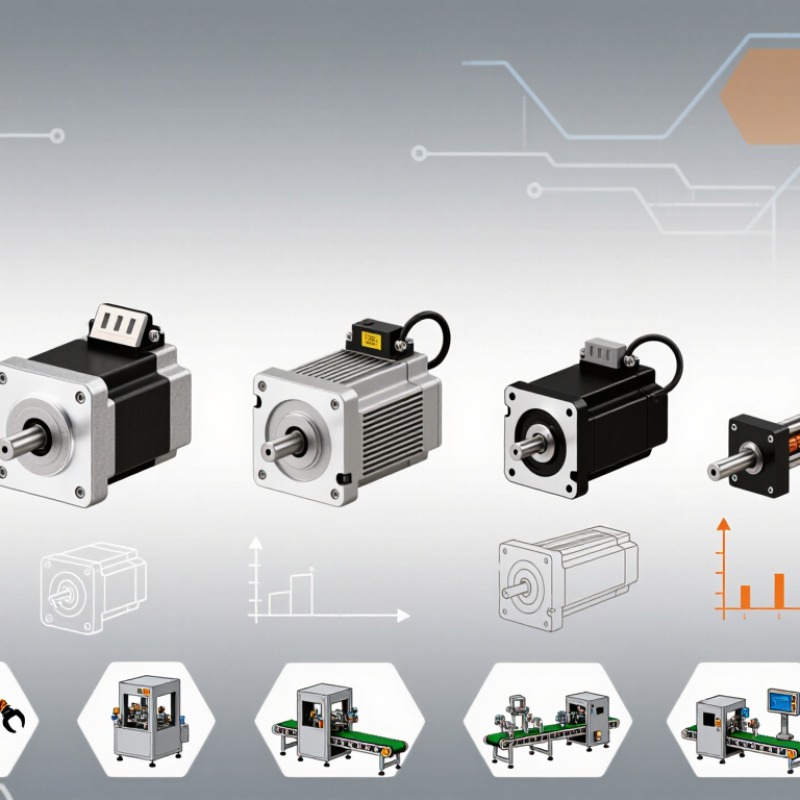
Precision motor selection begins with motion fundamentals: torque, speed, resolution, accuracy, repeatability, and duty cycle. A motor can provide fine resolution without delivering reliable positioning under load. Torque matters. Buyers should calculate acceleration, friction, payload, and the effects of vertical movement before comparing specifications.
Servo motors suit closed-loop applications requiring rapid correction and stable torque.
Stepper motors can offer simple control and strong holding force, but they may lose position during sudden overloads.
Brushless motors support efficient continuous operation, while direct-drive and linear motors reduce mechanical transmission errors in specialized systems.
The correct type depends on motion profile, not on resolution alone.
Environmental conditions deserve equal attention. Check operating temperature, humidity, dust exposure, vibration, mounting space, and cable flexibility. Confirm voltage compatibility, controller communication, feedback type, and maintenance requirements across the target market. Reliable suppliers should provide test data, dimensional drawings, tolerance information, and traceable quality records. Applicable safety and electromagnetic compatibility requirements also need verification before purchase.
I have seen projects fail because buyers measured speed but ignored heat buildup. Errors happen. A motor rated for peak torque may not sustain it continuously. Prototype testing under real load is more valuable than a perfect spreadsheet. No selection method is perfect; early assumptions should be challenged with measured noise, backlash, settling time, and long-duration performance.
Servo motors remain a leading choice for high-speed, closed-loop motion control in 2026. Their encoder feedback continuously compares commanded and actual shaft position. This enables precise correction during acceleration, reversing, and sudden load changes. In packaging lines, a servo can place labels within fractions of a millimeter while maintaining rapid cycle times.
Market evidence supports this demand. Fortune Business Insights valued the global servo motor market at approximately USD 13.92 billion in 2023. Its report projects the market to reach about USD 28.23 billion by 2032, with an 8.1% compound annual growth rate. Industrial buyers should still examine the application, not only the forecast. A motor rated for high speed may overheat when paired with an undersized drive, poor ventilation, or repeated peak loads. That mistake is common.
During selection, check encoder resolution, continuous torque, peak torque, inertia ratio, braking needs, and network compatibility. For a conveyor indexing every 400 milliseconds, low settling time may matter more than maximum rpm. For robotic joints, thermal capacity and backlash control deserve closer attention. IEC 61800-5-2 safety guidance can also help teams assess functional motion safety. However, compliance claims require verification from technical documents and testing. Datasheets are not enough. Real commissioning may reveal vibration, cable noise, or tuning errors. A sensible buyer requests load profiles, test curves, and service procedures before placing a global order. Servo systems are powerful, but not automatically efficient.
Servo motors provide high-speed operation with encoder feedback and continuous error correction. The chart compares representative rated-speed values commonly used in industrial motion systems; actual performance depends on motor size, load, drive settings, and application requirements.
2026 Best Precision Motor Types for Global Buyers
Stepper Motors for Cost-Efficient Positioning Applications
For global buyers, stepper motors remain practical for cost-efficient positioning. Their fixed step angles support repeatable movement in printers, inspection tools, conveyors, and small automation systems. A controller sends pulses, and the motor advances in measured increments. When the load is predictable, open-loop control can reduce wiring, sensor costs, and commissioning time. It is simple and useful.
Open-loop control is not magic. Missed steps may occur during sudden acceleration, binding, or excessive load. Selection should consider holding torque, operating speed, inertia, duty cycle, and ambient temperature. Microstepping can make movement smoother and reduce audible vibration, but it does not always improve absolute accuracy. That detail is often overlooked. A smaller motor may cost less initially, yet run hotter or require more frequent performance checks.
Experienced engineers normally test the complete mechanism, not the motor alone. Measure positioning error at low and high speeds. Check the shaft after repeated moves. Review connector quality, insulation ratings, documentation, and available replacement options across regions. A transparent datasheet should state torque curves, current limits, and recommended operating conditions. Buyers should also question optimistic assumptions. A stepper motor can be highly economical, but only when its limits match the real machine.
| Motor Type | Typical Step Angle | Typical Holding Torque | Practical Positioning Resolution | Recommended Speed Range | Open-Loop Capability | Relative Cost | Best-Fit Applications | Main Advantages | Key Limitations |
|---|---|---|---|---|---|---|---|---|---|
| Permanent-Magnet Stepper | 7.5°–15° | 0.01–0.20 N·m | 48–96 full steps/revolution; finer with microstepping | Up to approximately 600 rpm | Suitable for low-load, low-speed positioning | Low | Small valves, compact instruments, air vents, light-duty actuators | Simple construction, low purchase cost, good detent torque | Limited torque, lower resolution, and weaker high-speed performance |
| Variable-Reluctance Stepper | 5°–15° | 0.02–0.80 N·m | 24–72 full steps/revolution; microstepping depends on the driver | Up to approximately 1,200 rpm | Acceptable for non-critical loads with conservative acceleration | Low | Basic indexing, low-cost automation, educational and laboratory equipment | Light rotor, fast response, no permanent magnet required | No holding torque without energized phases; comparatively high vibration and noise |
| Two-Phase Hybrid Stepper | 0.9° or 1.8° | 0.10–12 N·m | 200 or 400 full steps/revolution; microstepping can provide thousands of command increments | Typically 300–1,500 rpm, load-dependent | Good for predictable loads and moderate acceleration | Low to medium | CNC axes, 3D printers, pick-and-place systems, laboratory stages, textile machinery | Excellent cost-to-torque ratio, high low-speed torque, broad frame-size availability | Can lose synchronism during overload; heating and resonance require proper tuning |
| Three-Phase Hybrid Stepper | 0.72°–1.2° | 0.30–15 N·m | 300–500 full steps/revolution; smooth microstepping is commonly available | Typically 500–2,000 rpm, depending on voltage and load | Suitable when smoother motion and reduced resonance are required | Medium | Precision stages, semiconductor handling, inspection systems, quieter automation | Lower torque ripple, smoother rotation, and improved mid-range performance | Higher driver and wiring complexity than two-phase designs |
| Closed-Loop Hybrid Stepper | 0.9° or 1.8° | 0.20–20 N·m | Encoder feedback supports commanded positioning; final accuracy depends on mechanics and encoder resolution | Typically 500–2,000 rpm | Yes; feedback detects following error and can correct or alarm | Medium to high | High-duty indexing, robotics peripherals, packaging, medical equipment, precision automation | Reduced risk of missed steps, better energy control, and improved reliability under variable loads | Higher system cost, more components, and greater commissioning effort |
| Linear Stepper Motor | Linear travel commonly 0.025–0.20 mm per full step | Force typically 10–500 N | Direct linear positioning; microstepping improves command resolution but not necessarily absolute accuracy | Approximately 10–500 mm/s, design-dependent | Suitable for short-stroke, low-to-medium load positioning | Medium | Optical stages, slide mechanisms, sample handling, compact laboratory automation | Direct linear drive, fewer transmission parts, compact integration | Limited travel length, force-speed trade-off, and possible missed steps under overload |
For global buyers, brushless DC motors are strong candidates for compact, efficient continuous motion. Their electronic commutation removes brush wear and supports long operating cycles. The result is cleaner rotation inside pumps, fans, conveyors, and small automation modules.
The U.S. Department of Energy estimates motor-driven equipment consumes nearly half of global electricity. The International Energy Agency places motor systems near 70% of industrial electricity demand. These figures make efficiency more than a purchasing detail. A BLDC motor with closed-loop control can maintain speed under changing loads, while an encoder helps detect position errors. Small frames also simplify installation where every millimeter matters. Heat remains the quiet problem. Poor ventilation can reduce service life, even when the rated efficiency looks attractive.
Buyers should compare duty cycles, torque at low speed, controller compatibility, noise, ingress protection, and local voltage requirements. IEC 60034 testing references can improve comparison between suppliers. In real installations, cable length and switching frequency may create electromagnetic interference. That issue is often missed. A 2024 industry market analysis forecasts continued double-digit growth for BLDC applications, driven by automation and energy-saving equipment. Forecasts are not guarantees. Engineers should request thermal curves, endurance results, and sample testing before volume orders. The cheapest motor may become expensive when unstable speed causes rejected products.
Servo motors deliver the strongest position accuracy, rapid acceleration, and closed-loop correction. They suit robots, CNC equipment, and high-speed packaging lines. Their encoders, drives, and tuning requirements raise total cost. Stepper motors cost less and simplify installation. They work well in printers, valves, and light-duty indexing. However, missed steps remain a practical risk under sudden loads.
BLDC motors offer efficient continuous rotation, compact size, and relatively low maintenance. They fit fans, pumps, medical devices, and battery-powered equipment. Their control electronics can narrow the initial price gap. Induction motors remain economical for rugged conveyors and general machinery, but they provide less positioning precision. The U.S. Department of Energy’s 2022 Motor Systems Market Assessment reports that motor systems use about 68% of industrial electricity in the United States. Efficiency deserves attention.
Application evidence matters more than catalog speed. The International Federation of Robotics reported 541,302 industrial robot installations worldwide in 2023, increasing demand for repeatable motion. In field sourcing, I compare settling time, thermal rise, encoder resolution, service access, and spare-part availability. Buyers often focus too heavily on peak torque. That is a mistake. My own early evaluations also underestimated cable quality and commissioning time. Actual cost includes integration, downtime, and operator training. A cheaper motor can become expensive after months of unstable positioning.
Encoder feedback compares commanded and actual shaft positions continuously. A servo corrects errors during acceleration, reversing, and sudden load changes. It can place labels within fractions of a millimeter.
Stepper motors suit predictable, cost-sensitive positioning tasks. Common uses include printers, inspection tools, conveyors, and light automation. Open-loop control can reduce wiring and commissioning time. It is simple.
Yes. Missed steps may occur during sudden acceleration, binding, or excessive load. Check holding torque, speed, inertia, duty cycle, and temperature. Microstepping can smooth movement, but it may not improve absolute accuracy.
A servo usually costs more because it needs encoders, drives, and tuning. A stepper costs less and often installs more simply. However, unstable positioning can make a cheaper motor expensive later. I once underestimated integration time.
Review encoder resolution, continuous torque, peak torque, inertia ratio, and braking needs. Confirm network compatibility and thermal capacity. For fast indexing, settling time may matter more than maximum speed. Catalog speed can mislead.
Brushless direct-current motors suit fans, pumps, medical equipment, and battery-powered systems. They provide efficient rotation, compact size, and relatively low maintenance. Their control electronics may increase the initial cost.
Induction motors suit rugged conveyors and general machinery. They are economical and durable for continuous operation. They provide less positioning precision than servo systems. That limitation matters.
Test the complete mechanism, not only the motor. Measure positioning error at low and high speeds. Check vibration, thermal rise, cable noise, and repeated movement. Request torque curves, load profiles, service procedures, and replacement options. Real commissioning may reveal surprises.
Choosing the right Precision Motor is essential for global buyers seeking reliable performance, accurate motion, and long-term value. This article introduces the fundamental factors used to evaluate precision motors, including speed, torque, positioning accuracy, control method, efficiency, operating environment, integration requirements, and total cost. It explains how application conditions should guide motor selection rather than relying on specifications alone.
The article compares three major motor types. Servo motors provide high speed, accurate feedback, and closed-loop control for demanding motion systems. Stepper motors offer cost-efficient positioning for applications with moderate speed and carefully managed loads. Brushless DC motors deliver compact size, efficient continuous rotation, and reduced maintenance for many automated devices. By comparing performance, cost, control complexity, and typical use cases, global buyers can identify the most suitable motor type for their equipment and balance precision, efficiency, reliability, and budget requirements.
